
How Software and AI Are Reshaping the Automotive Industry in 2026
The automotive industry is undergoing one of its most dramatic transformations ever — driven not by new body styles or engine designs, but by software, artificial intelligence (AI), and autonomous driving systems.
WideXP
Built to scale. Engineered to win.
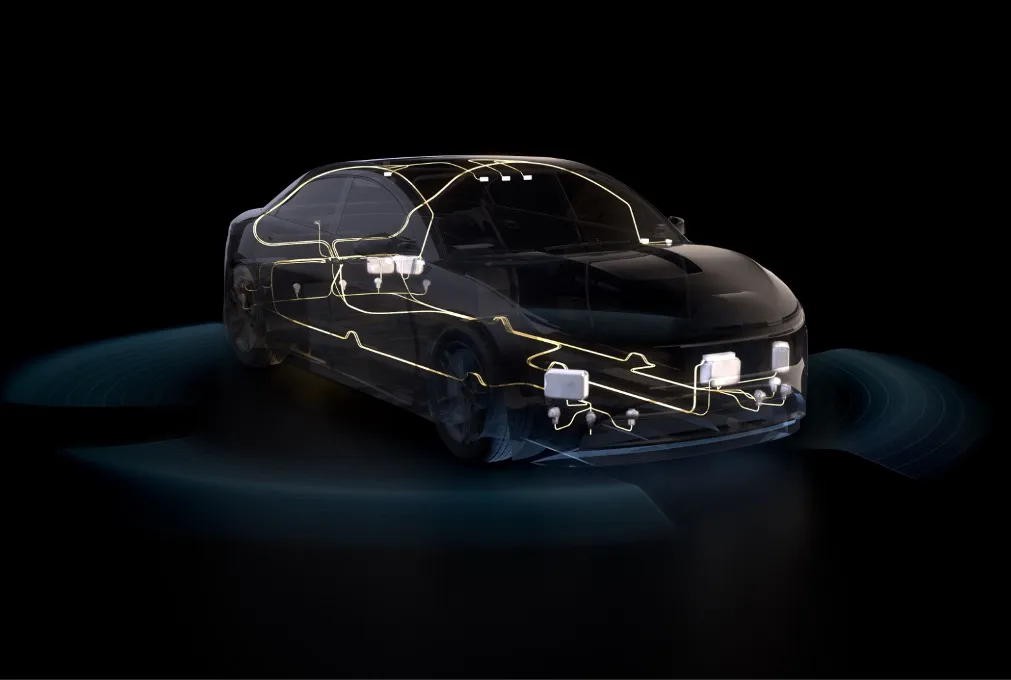
Image: Nvidia
The automotive industry is experiencing one of its most dramatic transformations in history, driven not by new body styles or engines but by software, artificial intelligence, and autonomous driving systems. In the past two weeks, major developments have highlighted how both technology companies and traditional automakers are racing to redefine the future of mobility.
At its latest GTC conference, NVIDIA unveiled a new wave of AI platforms designed not just for computation but for real-world execution. The company highlighted next-generation infrastructure capable of linking hundreds of GPUs into unified systems, new “AI factory” concepts for large-scale deployment, and expansions into robotics platforms such as Groot, Isaac, and Kamino. These systems are intended to power autonomous machines, industrial robots, and real-time decision systems, marking a shift from AI that thinks to AI that acts.
A central idea introduced is the concept of AI factories. Companies are no longer treating AI as a feature; instead, they are building entire infrastructures dedicated to training models, running inference continuously, and generating outputs at industrial scale. NVIDIA projects that demand for AI computing will reach trillion-dollar levels in the coming years, transforming AI from software into industrial infrastructure and from a tool into a production system.
Parallel to this is the rise of AI agents, a new software layer capable of planning tasks, executing actions, and interacting autonomously with other systems. Unlike traditional AI, which responds to commands, these agentic systems initiate activity and operate independently, behaving less like tools and more like digital workers.
As AI becomes more capable, hardware is emerging as the limiting factor. Companies are racing to build larger data centers, more efficient chips, and high-speed networking systems. Platforms like NVIDIA’s Rubin architecture focus on energy efficiency, scalability, and real-time processing, turning infrastructure into a strategic battleground where control over compute resources equates to control over the broader AI ecosystem.
This shift has profound implications. AI is leaving the screen and entering robots, factories, and real-world systems. Software is evolving from assisting humans to acting autonomously. Infrastructure has become the critical frontier, determining which companies will lead the industry. Execution speed is accelerating, with developments that once took years now being deployed in months.
Ultimately, AI is no longer an add-on layer to existing systems; it is becoming the engine behind operations, the decision-maker in workflows, and the controller of physical systems. The companies leading this transformation are not just building models—they are constructing the systems that increasingly run the world.
More News and Press releases

Venture capital is returning to biotech and healthtech with renewed intensity, but this is not a simple rebound. What is happening today represents a structural shift in how investors evaluate, fund, and scale innovation in life sciences.

For years, artificial intelligence lived mostly inside chatbots, dashboards, and data centers. That phase is ending. In the past week, announcements from NVIDIA show a clear shift: AI is no longer just generating text or images
The automotive industry is undergoing one of its most dramatic transformations ever — driven not by new body styles or engine designs, but by software, artificial intelligence (AI), and autonomous driving systems.

Venture capital is returning to biotech and healthtech with renewed intensity, but this is not a simple rebound. What is happening today represents a structural shift in how investors evaluate, fund, and scale innovation in life sciences.
Why WideXP
Deep financial and technical expertise
We merge industry knowledge with software development to create solutions that optimize payments, risk management, reporting, and customer experience.
Proven delivery and scalability
Our teams design and implement robust, secure, and scalable FinTech systems that integrate seamlessly with existing financial workflows, ensuring reliability as your organization grows.
Business-focused and strategic approach
We align technology initiatives with strategic goals, improving efficiency, ensuring compliance, and driving measurable impact across the financial ecosystem.
We welcome your questions and can recommend the best service for your needs.
Points of Contact:
USA, Texas, Houston: Robert Hinchcliffe
E-Mail: [email protected]
USA, NY, NY: Dewayne DeRozzo
E-Mail: [email protected]
UK, London: Darren Buddle
E-Mail: [email protected]
Poland: contact@widexp.com
Romania, Cluj: Bogdan Herciu
E-Mail: [email protected]